


You can visit roughly 36–42 countries visa‑free, with visa on arrival, or via eVisa/eTA as a Bangladeshi passport holder, but precise lists differ by index and timing. Core short‑stay options include the Maldives, Sri Lanka and Seychelles; others range from Caribbean isles to parts of Africa and Asia.
Stays, fees and documentation vary widely, so prepare passports, tickets, funds and any vaccine certificates. Keep official embassy sources handy if you want more detail.
Key Takeaways
- Bangladeshi passport holders have roughly 36–42 visa‑free or visa‑on‑arrival destinations depending on index and eVisa inclusion.
- Common accessible destinations include Maldives (30‑day VOA), Sri Lanka (eTA), and Seychelles (electronic ETA).
- Stay lengths vary widely — examples: Fiji 4 months, Jamaica 6 months, Seychelles 3 months, Comoros 45 days.
- Many countries require passport validity ≥6 months, onward ticket, proof of accommodation, and sometimes vaccination certificates.
- Always confirm eligibility, permitted duration, fees and entry rules with official embassy sites or IATA/Timatic before travel.
Quick Answer : How Many Countries Can Bangladeshis Visit Visa‑Free or On Arrival?
Generally, Bangladeshi passport holders can visit roughly 36–42 countries either visa-free or with a visa on arrival (VOA) depending on how you count eVisas and VOA options. You’ll find core destinations like Maldives (30‑day VOA), Sri Lanka (eTA), Seychelles (Electronic Border System), Bhutan (VOA with fee), Mauritius and Comomos offering straightforward entry.
Some states also relax rules if you hold valid Schengen/US/UK or other third-country visas, so you might gain simplified access to places such as Georgia or Mexico. Passport Ranking figures vary. Henley placed Bangladesh near 95th with about 36 entries, while other indexes report different tallies when eVisas are included.
Always verify durations, fees, health rules and documentation before you travel. New visa policies and entry rules can change frequently, so check official sources like the Ministry of Foreign Affairs before you go.
Visa‑Free Countries (Short List and Stay Limits)
Now that you know the overall scope of access Bangladeshi passport holders have, here’s a concise short list of places you can enter without a pre-arranged visa and how long you can stay. You’ll find roughly 36–42 destinations offering visa free, visa-on-arrival or e-visa options.
Notable visa free stays include Fiji (up to 4 months), Gambia (90 days) and Jamaica (up to 6 months). Island and small-state examples: Maldives (30 days VOA), Comoros (45 days VOA), Seychelles (3 months via Electronic Border System) and Mauritius (varies between visa free and pre-arrangement).
Several African and Caribbean states give VOA or e-visas — think Kenya (eTA up to 90 days), Sierra Leone and Barbados. Procedures differ; check entry requirements like return tickets or health certificates before travel. Applicants should also ensure they meet health and character requirements and carry any necessary documentation.
Visa On Arrival for Bangladeshi Passport Holders : What to Expect at Entry
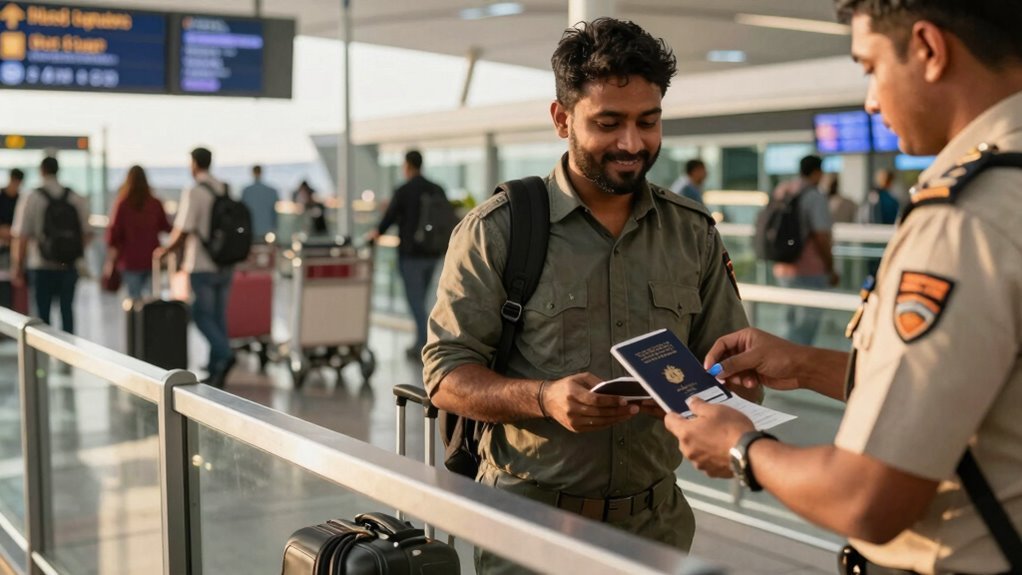
When you arrive under a Visa on Arrival scheme, have your passport ready (it should be valid for at least six months), plus a return or onward ticket, proof of where you’ll be staying, enough money for your trip, and any vaccination or third‑country visa paperwork that might be needed.
You’ll probably queue at a designated VoA counter, fill in arrival forms or complete an e‑arrival/ESTA/eVisa if required, pay the fee (often in local currency or sometimes USD), and then get a stamp or sticker showing how long you can stay.
Before you travel, check how long processing usually takes, what the maximum stay is, and whether extensions are allowed in that country so you don’t risk being turned away at the border.
Also, note that some countries require applications through a visa center such as VFS Global rather than direct embassy submission, so confirm the current application channel and document list before you go.
Arrival Documents Checklist
Before you reach the immigration counter, make sure you’ve got a compact folder of essentials ready to present: your passport valid for at least six months with blank pages, printed copies (and phone screenshots) of any approved eVisa/eTA or VOA confirmation, proof of onward travel and accommodation or an invitation letter, payment for any arrival fees in the accepted currency or by card, and required health certificates (for example, a yellow fever card when applicable).
Keep originals and duplicates accessible: officials often request electronic approvals before stamping a Visa or issuing VOA. Check fee amounts and accepted payment methods in advance—some destinations charge per night, others accept only cash in USD or local currency.
Finally, store documents in a slim organizer for quick inspection. Verify the agency’s credentials and certifications before relying on their guidance.
On-Arrival Procedure Steps
Wondering what to expect at arrival when you’ve opted for a Visa on Arrival (VoA)? You’ll arrive at an international entry point that explicitly offers VoA—airports, seaports or land borders, and present a passport valid for at least six months with a blank page. Have your return/onward ticket, proof of accommodation or invitation, and any required vaccinations ready.
Expect to complete an arrival form, pay the prescribed fee in local currency or major currencies, and possibly queue at a visa counter for stamping. Officials may ask for hotel reservations, proof of sufficient funds or supporting documents.
Processing can take 30–90+ minutes and VoA rules vary by country, so check specific entry requirements to guarantee valid travel and avoid surprises. Be aware that certain prohibited items cannot be carried on board and may affect your admissibility if discovered during inspection.
eVisa / eTA: Countries, Validity and Application Tips
Although eVisas and eTAs simplify entry for many Bangladeshi travellers, their rules and timelines differ sharply by country, so you need to check each destination’s specific validity, application window, fees and entry points before booking.
You’ll find options like Kenya (eTA: up to 90 days; apply 3–90 days prior; USD 32.50), Sri Lanka (Standard eVisa: 60 days in any 6-month period; fees vary), Ethiopia (90 days; arrive via Addis Ababa) and many 30–60 day eVisas elsewhere.
Prepare passport data, photo, onward ticket, hotel or invitation and required vaccines. Confirm permitted ports, mixed eVisa/VOA processes and recent policy changes.
Many travellers also benefit from checking travel-agency package options that bundle visas, flights and local support for smoother processing.
| Country | Typical eVisa validity |
|---|---|
| Kenya | 90 days |
| Sri Lanka | 60 days |
| Ethiopia | 90 days |
| Papua New Guinea | 60 days |
Overseas Territories & Special Cases (Mayotte, Virgin Islands, Etc.)
Don’t assume an overseas territory follows its mainland’s visa rules: many, like Mayotte, the British and U.S. territories, set distinct entry regimes.
Don’t assume overseas territories mirror mainland visas; many enforce their own, separate entry rules.
You’ll find Mayotte listed among destinations offering visa-free or visa‑on‑arrival access for Bangladeshi passport holders in 2026, but that doesn’t remove other checks.
The British Virgin Islands similarly appears under simplified entry arrangements, yet its rules can diverge from the UK.
Several Caribbean territories (Montserrat, Saint Kitts and Nevis, Saint Vincent and the Grenadines) also offer favorable, territory‑specific access.
Before you travel, confirm duration limits, entry fees and required documents: return ticket, accommodation proof or health certificates are commonly requested even with visa‑free status.
Policies shift frequently, so verify territory‑specific guidance from official sources shortly before departure.
Yas Mall is a major example of a territory offering extensive family entertainment options that travelers should consider when planning visits.
Entry Using Third‑Country Visas or Residence Permits (US, Schengen, GCC)
If you have a valid Schengen visa or a residence permit from the US, GCC states, or other OECD countries, you can often get into several places that normally require visas for Bangladeshi passport holders.
Countries such as Georgia, Azerbaijan, Mexico and some in the Balkans and the Gulf offer visa‑free entry, e‑Visas, or visa on arrival when your third‑country visa is multiple‑entry and meets the destination’s minimum validity requirement.
Do check each country’s exact rules and how long your visa must remain valid before you travel, so you don’t get an unpleasant surprise at the border.
Also note that some destinations introduced or expanded e-Visa systems recently (for example Thailand launched an e-Visa in 2025), so always verify current entry procedures before you travel.
Entry With Schengen Visas
When you hold a valid multiple‑entry Schengen visa (or a US, UK, Canadian, Australian, Japanese, or New Zealand visa or residence permit), several countries extend simplified entry rules that can save you from applying for separate visas.
You can use that Schengen status to access places like Albania, Montenegro, Serbia and Mexico, often visa-on-arrival or visa-free if you meet conditions.
Georgia and Azerbaijan offer e‑visa or visa‑free access with Schengen or OECD visas; fees are sometimes waived.
Saudi Arabia and Qatar provide eVisas or visas on arrival when you hold eligible Schengen/US/UK tourist visas or residence permits, subject to platform rules.
Check each country’s list, validity requirements and intended‑stay limits before travel to avoid refusals.
Consider timing your travel to avoid peak seasons like Ramadan or Hajj for a less crowded and more comfortable pilgrimage experience.
Access Using GCC/US Residency
With a valid GCC or US/Schengen/UK (or other major OECD) residence permit or multiple‑entry visa, you can gain easier entry to several countries that otherwise require visas for Bangladeshi passport holders.
Many states—Azerbaijan, Mexico, Serbia, Georgia, Albania, Montenegro and parts of the Caribbean/Latin America—offer visa‑free entry, eVisas, or visas on arrival when you hold qualifying third‑country visas or residence permits.
GCC residence permits specifically enable VOAs or short stays in places like Azerbaijan (up to 90 days), Georgia (15 days) and Qatar under certain rules.
South Korea and some transit hubs also admit holders of US/Schengen/other OECD permits for brief visits.
Always confirm eligibility, allowed duration, fees and documentary requirements before travel; policies change and your global passport strategy depends on current entry conditions.
Some countries additionally allow entry based on long‑term residency permits such as GCC or US visas, which can be useful while pursuing longer‑term residency or citizenship options elsewhere.
Short‑Stay Rules: Stay Limits, Single vs Multiple Entry, Common Fees
Although short‑stay rules vary widely, you’ll usually encounter clear limits on how long you can stay, whether the stamp allows single or multiple entries, and small administrative fees or conditions that affect entry.
You’ll see a mix: long visa‑free stays (Fiji, Jamaica), short visa on arrival entries (Maldives, Comoros), and pre‑arrival ETAs (Seychelles).
Know single vs multiple‑entry status, typical fees, and common documentary checks.
| Country | Stay limit | Entry/Fees |
|---|---|---|
| Fiji | 4 months | Single/multiple per stamp |
| Jamaica | 6 months | Typically single; may extend |
| Maldives | 30 days | Visa on arrival; no prepay |
| Seychelles | 3 months | ETA ≈ EUR 10 processing fee |
| Comoros | 45 days | Visa on arrival; cash payment |
Health & Documents to Avoid Refusal (Vaccines, Yellow Fever, Proof of Funds)
Because entry can hinge on a few specific documents and vaccinations, you should prepare them well before travel to avoid refusal at the border. Check destination rules: yellow fever vaccination (get it ≥10 days prior and carry the International Certificate of Vaccination), routine vaccines, and any country‑specific requirements. Keep originals and digital copies to counter passport holds or technical issues.
- Passport bio‑data page valid ≥6 months and printed e‑authorizations.
- Yellow fever card (WHO paper or digital) if arriving from endemic areas.
- Proof of funds: bank statements, credit cards, or cash (USD 100–150/day baseline).
- Onward ticket, confirmed hotel booking, invitation/itinerary when requested.
Use embassy sites or IATA Timatic to verify rules well before departure.
Practical Airport Tips and Applying (Timing, Payments, Photos, Arrival Fees)
If you want a smooth arrival, prepare key documents, exact payment methods, and backup copies before you leave home.
Arrive with a passport valid six months beyond departure, printed return/onward ticket, hotel booking or invitation—immigration or VOA desks (Kenya eTA, Seychelles EBS, Maldives VOA) will check them.
Apply using Smart timing: submit eVisas/eTAs in recommended windows (Kenya up to 90 days, Sri Lanka 60 days) and print confirmations.
Carry exact cash or card for arrival fees—some islands insist on cash; fees vary (Seychelles EUR 10, Bhutan SDF USD 15/night).
Bring two passport photos (45×35 mm) and photocopies of biodata and visa/eTA to speed queues.
Use the specified entry point and keep yellow fever certificates ready when required to support global mobility.
Verify Rules Before Travel: Official Sources, Embassy Contacts, Checklist
When planning your trip, verify entry rules directly with the destination’s official government or embassy sources so you’re not blindsided by last‑minute changes to visas, eTAs, or health requirements.
You should routinely check official sites for visa-on-arrival, eVisa fees, and validity differences by nationality, and note passport validity and blank-page rules.
- Confirm passport validity (usually 6 months) and required blank pages.
- Check vaccination/health mandates and carry paper + digital certificates.
- Contact the destination’s embassy/consulate for exemptions tied to third‑country visas or residence permits.
- Prepare supporting documents: return ticket, hotel booking, proof of funds, travel insurance, and save screenshots/prints of approvals.
Do this well before booking travel to avoid denials or costly changes.
Frequently Asked Questions
In Which Country Can Bangladeshi Go Without a Visa?
You can visit places like Fiji, Jamaica and the British Virgin Islands visa‑free, and others (Maldives, Comoros, Sri Lanka) offer visa‑on‑arrival or eVisa options.
You’ll need to check entry requirements carefully — passport validity, possible vaccinations, and return tickets — and assess travel safety before booking.
Some countries admit you if you hold Schengen/US/UK/Canada visas. Always confirm current rules with official sources before you travel.
Which Country Has the Weakest Passport?
As of 2026, Bangladesh is often cited as having one of the weakest passports. You’ll see its low global ranking and severe travel restrictions reflected in indices like VisaGuide and Henley.
You should note this means limited visa-free access—roughly 36–42 destinations—and frequent prior-visa requirements. You can analyze mobility gaps, diplomatic reach, and policy factors to understand why such passports score poorly and face persistent barriers to international travel.
Is Bangladesh a Strong Passport?
No you don’t have a strong passport. You face limited passport strength, limited regional mobility, limited global reach.
You can visit some nearby or niche destinations visa-free or with visa-on-arrival, but major regions like Schengen, the US, Canada, Japan and Australia generally require visas.
You’ll often rely on third-country visas or eVisas to expand options. Check entry rules carefully, plan ahead, and expect more paperwork than travelers from stronger passports.
Is Bangladesh Visa-Free for the USA?
No — you’re not visa-free for the USA. You must meet US entry requirements and obtain a US visa in advance; Bangladesh isn’t part of the US visa waiver program.
You’ll complete Form DS-160, pay the MRV fee, schedule an interview at the US Embassy in Dhaka, and provide supporting documents and biometrics.
Visa issuance remains discretionary, so prepare evidence of ties and intent to satisfy consular officers and improve your chances.
Conclusion
You’ve got more options than you might think, but rules change fast—so check official sources before you go.
Treat each visa-free or visa‑on‑arrival country like a different key: it might open the door, but it won’t guarantee entry unless your documents, health proofs, and funds are ready.
Plan timing, photos, and payments, verify embassy guidance, and keep contingency funds. Travel smart, prepare thoroughly, and you’ll turn opportunities into smooth journeys.
0 Comment