
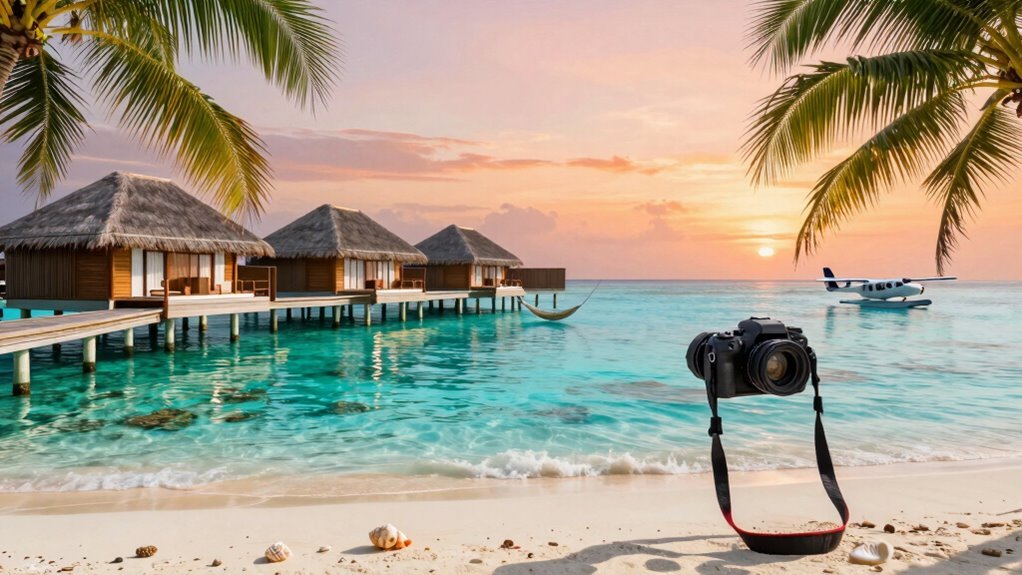

You’ll time your trip for the clearest water—November–April for calm seas and top visibility, with shoulder months (late October, May) as savvy savings.
Pick an atoll to match your mood: Baa for mantas, South Ari for whale sharks, Kaafu for quick access.
Balance seaplane splurges with speedboat or domestic-flight options to cut costs, and split stays between beach and overwater villas.
Keep essentials, insurance and flexible transfers handy—more practical tips follow.
Key Takeaways
- Visit November–April for the clearest skies, calm seas and best underwater visibility, with shoulder months offering savings.
- Choose transfers (seaplane, domestic flight+speedboat, or speedboat) based on budget, luggage limits and daylight restrictions.
- Balance budget and experience by splitting stays between a local guesthouse and a resort or between beach and overwater villas.
- Plan 4–7 days minimum, prebook transfers and flexible rates to allow weather windows and avoid rushed itineraries.
- Pick atolls for activities: Baa for mantas, South Ari for whale sharks, and Kaafu for shortest transfers.
Quick Planning Checklist: When to Go, Where to Stay, Transfers
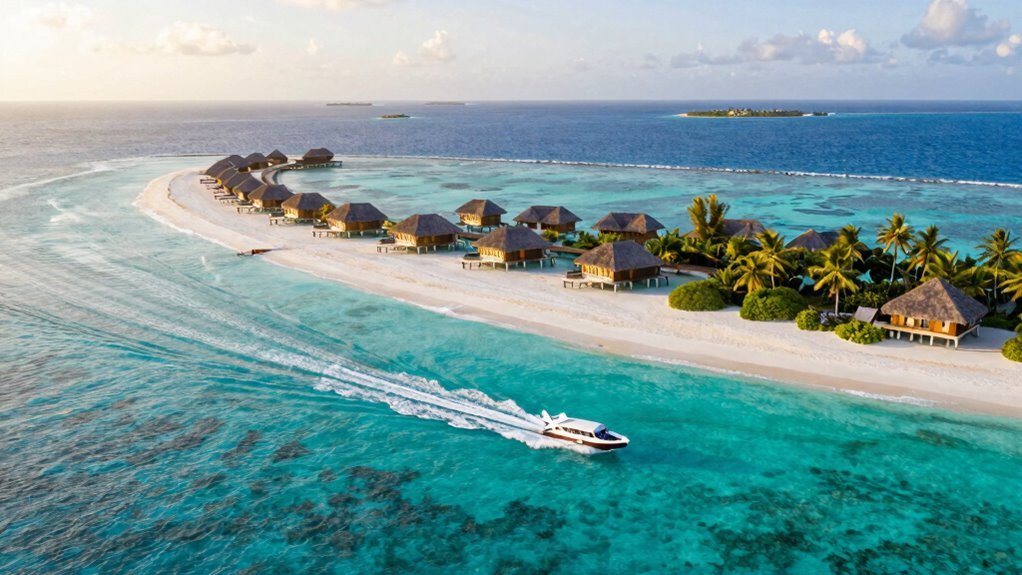
If you want the clearest water and the sunniest days, plan your trip for November–April, with late October or early May offering shoulder‑season savings; pick accommodation that matches your travel style—from budget guesthouses on local islands for cultural immersion to luxury overwater villas (water‑villa rates commonly run $700–$1,000+ per night, though some cheaper options are $250–$500)—and allow at least 4–7 days so you can factor in transfers and activities without rushing.
Visit November–April for clear water and sun; choose guesthouses for local charm or overwater villas for iconic luxury.
For the best time to visit, aim for dry, calm seas ideal for snorkeling and diving.
Choose guest houses for local flavor or overwater villas for iconic luxury.
Factor seaplane versus speed boat options into budget and transfer time; grouping stays within one atoll cuts costs.
Also consider day trips to nearby islands and marine parks like Blue Bay Marine Park to experience vibrant coral reefs and snorkeling.
Where Are the Maldives and What Atolls Mean for Your Trip
Stretching about 871 km southwest of Sri Lanka, the Maldives is basically a necklace of 1,192 coral islands grouped into 26 natural atolls. Each atoll has its own lagoons, house reefs and marine life.
Which atoll you pick shapes pretty much everything: the transfer type and travel time (expect seaplanes for far-flung atolls, domestic flights plus a speedboat or just a speedboat for closer ones), the cost, and even the wildlife you’re likely to see. So choose an atoll for its highlights — South Ari if you want whale sharks, Baa for manta-rich biodiversity, or North/Kaafu for quick access — and you’ll set the tone for your whole trip. Winter months (November–March) offer the most pleasant weather for island hopping and outdoor activities, making it an ideal time to plan your visit to the Maldives and nearby regions with mild, sunny weather.
Location And Geography
Along a shimmering arc in the Indian Ocean southwest of Sri Lanka and India, the Maldives unfolds as about 1,192 coral islands clustered into 26 natural atolls, a ribbon of land and lagoon stretching roughly 871 km. You’ll find narrow, low islands where turquoise waters lap coral reefs and lagoons teeming with life.
Most resorts occupy whole islands, so choosing an atoll shapes your days — diving, surfing or solitude. Transfers from Velana International Airport set the tone: nearby atolls use speedboats while outer atolls need domestic flights or seaplane transfers, adding adventure and travel time.
Consider distances, activities and marine habitats when planning island hops.
- Pick an atoll for your main activity.
- Balance transfer time with relaxation.
- Prioritize reef access and privacy.
The Maldives’ commitment to marine conservation and sustainable practices helps protect coral reefs and local wildlife unique wildlife for future visitors.
Atolls And Travel Impact
When you pick an atoll, you’re choosing more than a backdrop—you’re shaping travel time, costs and the wildlife you’ll see; Kaafu (Malé) Atoll keeps transfers short with speedboats, while outer rings like Baa, Laamu and Noonu often mean domestic flights or seaplanes (add $200–$500 roundtrip) and extra travel days.
The Maldives’ 26 atolls stretch across 871 km, each a ring of coral protecting vivid lagoons and thriving reefs.
Choose South Ari Atoll for near‑guaranteed whale‑shark encounters, or Baa Atoll for manta aggregations and UNESCO‑backed biodiversity.
Resorts usually own whole islands, so staying within one atoll lets you island‑hop cheaply and avoid repeated transfers.
Think logistics and marine priorities first—your atoll shapes the trip’s rhythm, costs and underwater encounters.
Singapore’s efficient public transport and island‑wide connectivity make it easy to pair a Maldives stay with a stopover or extension in the city.
When to Visit: Weather, Visibility and Value by Month
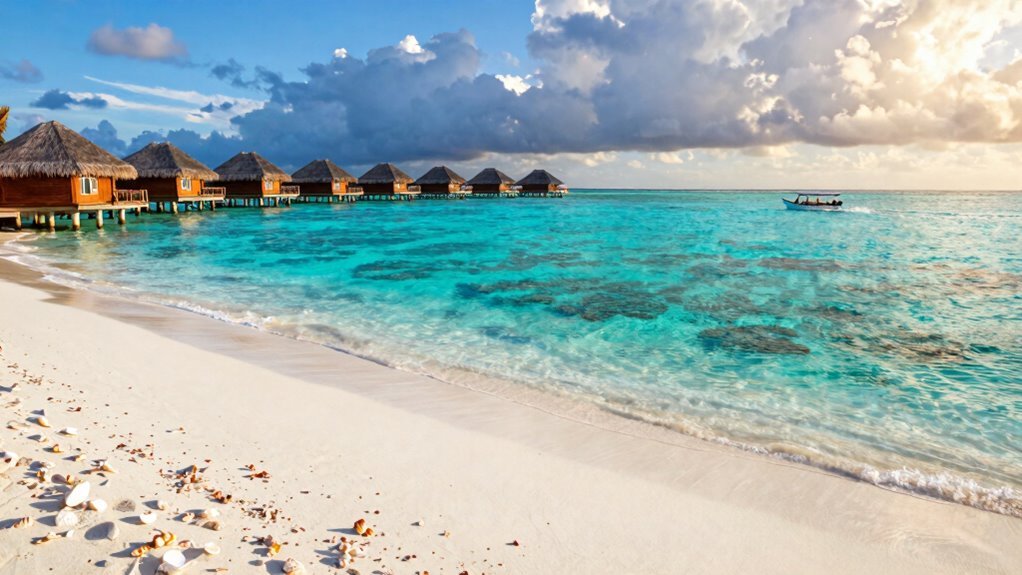
You’ll get the clearest skies and calmest seas between November and April, when low rainfall and superb visibility make snorkeling and scuba conditions at their best.
If you want to save money, aim for the wetter months of May–September or the shoulder periods in October and late April–early May, when rates fall and water clarity often improves.
Decide whether you care more about perfect weather and visibility or better hotel value, and pick your timing accordingly.
Consider planning multi-destination trips that combine islands and inland highlights like the Chocolate Hills to make the most of varied weather and activities.
Best Weather Window
If you want the clearest skies, calmest seas and the best underwater visibility for diving and snorkeling, plan your trip between November and April, when the dry season delivers blue days and steady conditions.
That’s the best time to go — high season brings peak visibility, calm waters and minimal transfer disruptions, so seaplane and speedboat rides are more reliable.
October and late April are attractive shoulder-season windows with lower rates and still-good clarity, though occasional short showers pop up as the monsoon shifts.
The southwest monsoon (May–September) cools crowds and prices but roughens seas and visibility.
- Book dives early in dry-season mornings for maximum underwater visibility.
- Use shoulder-season deals to splurge on resorts or excursions.
- Favor November–April for dependable seaplane transfers.
Aerial views also reveal dramatic glacial river braids and contrasting volcanic terrain that highlight nearby geological spectacles.
Rainy Season Value
Value often hides behind the clouds in the Maldives: the rainy season (May–September) brings more showers, choppier seas and lower underwater visibility, but it also delivers the steepest discounts on resorts, transfers and excursions.
If you prioritize cost over picture‑perfect skies, the monsoon-influenced months offer the best hotel value and plentiful discounts — think lower room rates, package deals and cheaper seaplane transfers.
Expect higher humidity, more frequent downpours and muddier snorkeling conditions; manta and whale‑shark sightings become less reliable.
Consider late October or early May as shoulder alternatives for better visibility with fewer crowds.
Book refundable rates, plan flexible itineraries and buy travel insurance so you can chase the clearest windows, time dives around weather, and still save considerably.
Doha offers convenient international connections and transit options for many travelers heading to the Maldives, making it a practical hub for flights and transfers to the islands, especially when booking through major carriers or regional hub services like Doha transit.
Getting to the Maldives: Malé, Seaplanes, Domestic Flights & Boats
Touch down at Velana International Airport and you’ll immediately be planning the next leg of your journey, because most resorts sit far from Malé and require a seaplane, a domestic flight plus speedboat, or a direct speedboat transfer. From the terminal, choices feel cinematic: a Trans Maldivian seaplane skims turquoise lagoons, pricier and daylight bound with luggage limits; a budget minded domestic flight drops you at a regional airport followed by a 30–50 minute speedboat; or a quick speedboat transfer whisks you to nearby islands.
Expect seaplane fares around $400–$500 round trip and strict luggage rules.
Domestic flight plus speedboat runs $100–$250 one way; boats add travel time.
Speedboat transfers cost $100–$300 round trip and avoid seaplane limits.
Confirm transfer schedules, allowances, and prebook through your resort.
Consider traveling in the off-season to potentially lower transfer and accommodation costs.
Choose Your Island: Best Resorts for Romance, Family, Adventure, Wellness
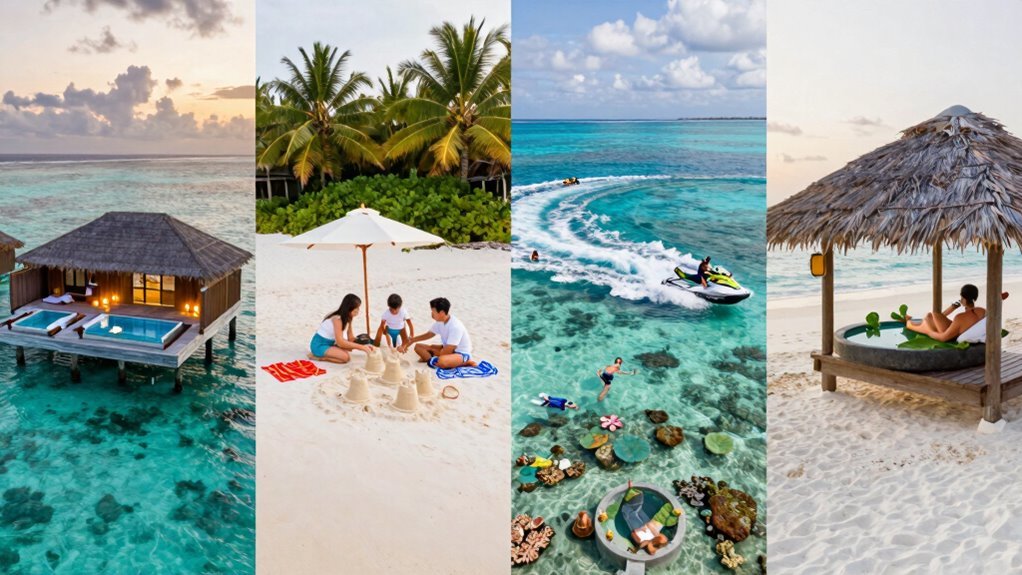
When you’re choosing an island, think less about ticking boxes and more about the mood you want to wake up to: moonlit infinity pools and private stargazing for romance, shallow turquoise lagoons and kids’ clubs for family ease, world‑class reefs and guided dives for adventure, or calm beachfront spas and nightly wellness rituals for a restorative escape.
For honeymoon seclusion, Soneva Jani’s overwater villas with private pools and retractable roofs deliver unforgettable nights. Plan at least three nights.
Families thrive at Lily Beach Resort & Spa or Hideaway Beach Resort, where kids’ clubs and gentle lagoons make parenting easy. South Ari offers whale‑shark encounters.
Divers should target Maafushivaru or South Ari for superb diving and close marine life encounters.
Choose Six Senses for dedicated spa and wellness programs or Kanuhura for balanced luxury.
Consider the best time to visit the Maldives to align with diving and weather conditions, especially the drier months.
Overwater Villa or Beach Bungalow? How to Pick and What to Ask
You’ll balance the cinematic thrill of an overwater villa—glass floors, direct reef access and postcard views—with the easy, sandy privacy of a beach bungalow that’s often better for families and shore swimming.
Ask for a map that shows your villa’s position, the lagoon depth, how far the reef is and what the typical currents are so you can check whether the snorkeling or calm shallows match your plans.
And be sure to confirm which extras are included or charged—snorkel gear, transfers, minibar, insect control—and ask about options like split stays or night‑sky features so there are no surprises.
Also consider the best time to visit and seasonal conditions in the region, since the dry season offers sunnier skies and calmer seas for snorkeling and boating.
Overwater Villa Pros/Cons
Whether you crave waking to the hush of lapping water right beneath your deck or prefer stepping straight onto warm sand, choosing between an overwater villa and a beach bungalow comes down to priorities: direct reef access and dramatic views versus easier shore access, more space, and often lower cost.
Overwater villas (water villas) deliver cinematic sunrise/sunset panoramas, private ladders into coral gardens, and the thrill of snorkeling from your deck; expect higher nightly rate ranges and ask what nightly rate inclusions cover. Consider splitting stays to sample both without the full premium.
Before you book, confirm seaplane transfer logistics, luggage weight limits, villa orientation, and the house reef condition for marine life.
- Check nightly rate inclusions and snorkel gear
- Ask about seaplane transfer and luggage limits
- Verify villa position for sunrise/sunset and reef quality
Beach Bungalow Benefits
A beach bungalow gives you effortless access to sun and sand. Step out of your door onto a private stretch of beach, enjoy larger garden spaces and roomier indoor/outdoor bathrooms, and move kids and gear around without stairs or ladders.
Choose a beach bungalow when you want direct sandy access, private gardens and a family friendly layout that keeps little ones safe and close. Beach villas often cost less to reach: nearby resorts use boat transfers (cheaper and quicker) versus seaplanes to outer-atoll water villas.
Still, ask about reef health, marine sightings and privacy distances, plus villa features like private pools or butler service. For variety, split your stay—one night overwater for reef access, then relax in a beach bungalow.
Top Maldives Activities: Snorkeling, Diving, Surfing, Sandbanks & Stargazing
By diving, snorkeling, surfing or simply drifting on a private sandbank under the Milky Way, you’ll discover why the Maldives feels like a playground for sea and sky lovers.
You’ll snorkel South Ari Atoll’s clear shallows from water villas and often meet whale sharks. Diving reveals 1,000+ sites: drift through Fish Head and Maaya Thila, or time trips for manta aggregations (best Oct–Apr).
Surfing peaks May–Sep on eastern atolls like Thulusdhoo with consistent reef breaks for intermediate and expert riders.
Sandbanks and desert islands give you private turquoise lagoons for swimming, snorkelling and overnight stillness.
For stargazing, choose resorts with observatories or guided sky sessions to see the Milky Way far from light pollution.
Practical tips:
- Hire licensed guides for safety and local knowledge.
- Time dives for manta/whale shark seasons.
- Pack reef safe sunscreen and snorkel gear.
How Long to Stay + Sample Itineraries (Maldives-Only and Add-Ons)
If you want to properly unwind and tick off the Maldives’ highlights, plan for at least 4–5 days, but aim for a week: seven nights lets you split time between a beach villa for island activities and a water villa for snorkeling off your deck and a private sandbank picnic, while 3–4 nights can serve as a restful add-on after a longer Asian circuit.
For a Maldives-only rhythm, take seven days: Day 1 arrive Malé then seaplane to resort islands, three nights in a beach villa exploring local life and watersports, three nights in a water villa savouring snorkel-filled mornings and sunset cocktails, depart Day 8.
Combine with Sri Lanka or India by tacking on 3–4 Maldives nights after your main trip to enjoy true one island time.
Practical Packing & Essentials: Health, Visas, Money and Family Tips
When packing for the Maldives, think light but deliberate: your suitcase should balance sun-ready gear with a few practical safety items because remote islands mean limited shopping options and strict transfer limits.
Carry a passport valid six months and proof of onward travel for the visa on arrival; tuck prescriptions and copies into your carry‑on.
Bring reef‑safe sunscreen, a compact first‑aid kit and children’s gear if needed.
Confirm seaplane transfers and luggage allowances with your resort, and buy travel insurance that covers medical evacuation and domestic flights.
- Take small, clean USD/EUR bills plus some Maldivian Rufiyaa for local markets and tips.
- Pack family life jackets or confirm resort sizes for kids’ safety.
- Keep electronic copies of documents and insurer contacts.
Maldives Budget Guide: Mid-Range to Ultra-Luxury Costs and Saving Tips
Having sorted passport copies, reef-safe sunscreen and seaplane luggage limits, it’s time to look at what your Maldives trip will really cost.
You’ll see mid-range resorts and guesthouses from $100–$400/night, luxury villas $700–$1,000+, and ultra luxury above $2,500.
Internal transfer costs can be substantial: speedboat $100–$300 RT, domestic flight+speedboat $200–$400 RT, seaplane transfers $400–$500 RT per person.
Travel in shoulder season (late October or May) for lower rates; May–September gives deepest discounts if you accept rain.
Split stays between local islands and resorts, pick properties near Malé to avoid seaplane transfers, and consider an all-inclusive package for predictable spending.
| Option | Typical cost |
|---|---|
| Local islands | $50–$150/day |
| Mid-range resorts | $100–$400/night |
| Seaplane transfers | $400–$500 RT |
| Luxury/ultra | $700–$2,500+/night |
Frequently Asked Questions
Can I Celebrate a Honeymoon or Vow Renewal on a Local Island Instead of a Resort?
Yes you can celebrate a honeymoon or vow renewal on a local island. You’ll find affordable venues and stunning photography spots, but follow community regulations and cultural etiquette: arrange local ceremonies respectfully, dress modestly when required, and ask about permit requirements early.
You’ll work with local coordinators who’ll help you blend celebration and tradition, creating evocative moments while supporting the island community and ensuring a seamless, memorable experience.
Are There Dietary Restrictions or Halal Options Widely Available at Resorts?
Think of a resort buffet as a garden: you’ll find designated Halal dining paths, clear Seafood restrictions, and labeled Vegetarian options so you can pick safely.
Resorts usually offer Alcohol policies that separate or restrict service, Prayer facilities for convenience, and transparent Food sourcing from local fishermen and farms.
You’ll want to ask ahead for certification details and special meal requests; staff are typically happy to accommodate dietary needs and religious practices.
What Mobile/Data Connectivity and eSIM Options Work Best in the Maldives?
You’ll find eSIM compatibility works well for short stays; activating local data packages on arrival keeps roaming costs low. Buy Local SIMs at Malé airport or kiosks; Airport Wi‑Fi helps initial setup.
Resorts vary in coverage, so check signal strength and consider portable signal boosters for remote atolls. Compare data packages from Dhiraagu and Ooredoo for speed and price, and top up before transfers to avoid unexpected roaming charges.
Can I Work Remotely From an Overwater Villa—Are Internet Speeds Reliable?
Absolutely—it’s usually possible to work from an overwater villa; internet can be surprisingly fast as a lightning bolt.
You’ll want to confirm high speed stability and ask about remote workspaces, business center access, and backup connectivity.
Do latency testing for video conferencing readiness and bring a hotspot or eSIM for redundancy.
Resorts vary, so verify speeds, peak-hour performance, and whether staff support remote meeting setups before booking.
Do Resorts Accommodate Guests With Limited Mobility or Medical Needs?
Yes, many resorts accommodate guests with limited mobility and medical needs. You’ll find adapted rooms, wheelchair access ramps, accessible transport between docks and villas, and mobility equipment on request.
Staff can arrange service animals and coordinate medical evacuation plans if needed. Describe your needs when booking so they’ll prepare elevators, widened doorways, grab bars, and local clinic support, ensuring a safer, more comfortable stay tailored to you.
Conclusion
You came for sun, sand and impossibly blue water, and left with the quiet smugness of someone who’s learned that paradise is almost as complicated as booking it.
You’ll still argue about which atoll was best, but you’ll sleep under a ceiling of stars and wake to fish nibbling the reef outside your villa.
So yes, it’s expensive, remote and annoyingly perfect, and exactly the kind of hassle you’ll happily repeat.
0 Comment