
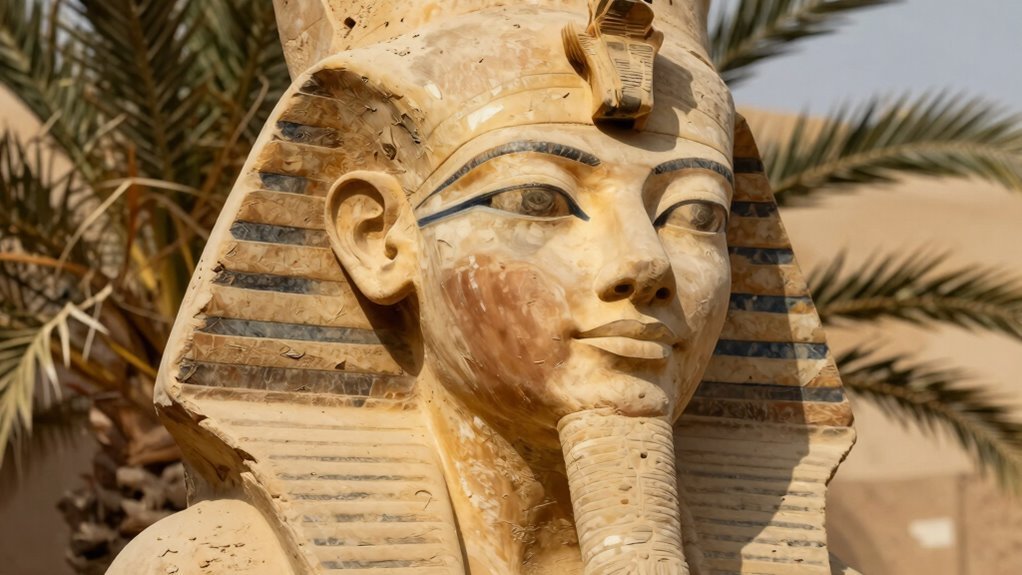

If you ask who the first pharaoh was, archaeological and epigraphic evidence points to Narmer as the historical founder of a unified Egypt, with the Narmer Palette, serekh inscriptions, and wide‑ranging sealings showing royal titulary and conquest symbolism.
Later literary traditions name “Menes,” likely an honorific or composite founder, while Hor‑Aha appears as a key consolidator of administration.
The material record favors Narmer’s role, though gaps remain. Keep going and you’ll find how texts, lists, and new finds complicate the picture.
Key Takeaways
- Archaeological and inscriptional evidence strongly supports Narmer as the historically attested ruler who unified Upper and Lower Egypt.
- The Narmer Palette and widespread serekh inscriptions show royal symbols (crowns, uraeus) linking Narmer to early pharaonic authority.
- Later literary sources name “Menes” as the founder, but this likely represents a later honorific or composite figure, not a clear contemporary name.
- Hor‑Aha is a plausible alternative or successor, credited with administrative consolidation and institutionalizing the unified state.
- King lists and classical accounts are valuable but politically shaped and must be weighed against contemporaneous archaeological data.
Was Narmer the First Pharaoh of Egypt?
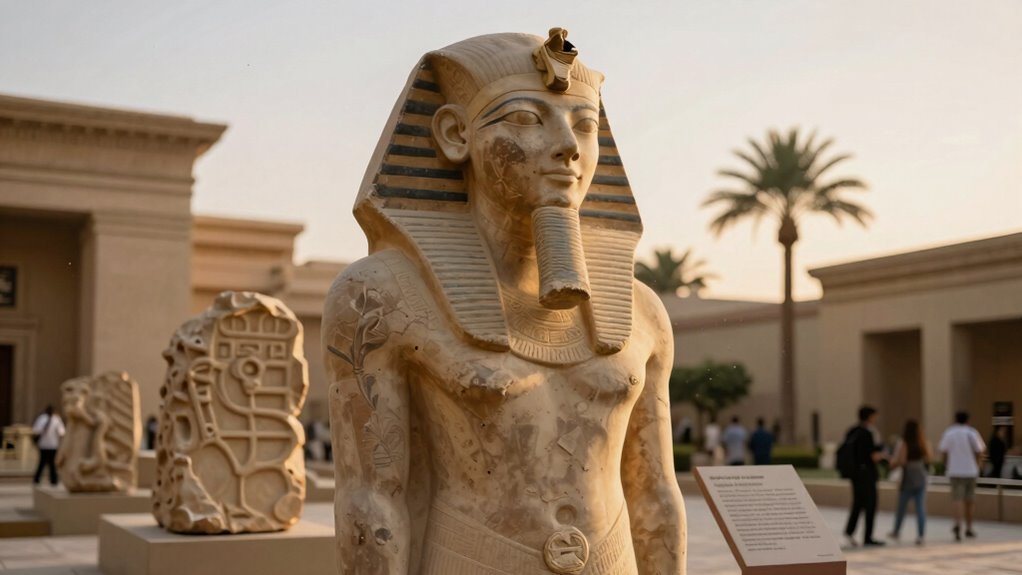
Although absolute certainty eludes us, the preponderance of archaeological and epigraphic evidence points to Narmer as the first pharaoh of a unified Egypt. You should weigh the Narmer Palette, Abydos necropolis sealings, and Qa’a and Den impressions as convergent sources: they consistently place Narmer at the start of Dynasty I and depict his dual-rule claims. Contextualized in ca. 3180–3120 BC, Narmer’s iconography—white and red crowns, uraeus, royal beard—serves as deliberate Narmer symbolism asserting sovereignty. You’ll note military strategy on the Palette: Upper Egyptian forces and Thinite confederates are shown subduing Lower Egypt, complemented by diplomatic consolidation and the founding of Memphis. While some debate Menes’ identity, the balance of evidence makes Narmer the most persuasive candidate. Archaeological finds such as the Abydos sealings further support Narmer’s primacy. Evidence from later royal memorials and temple iconography also reinforces his central role in early state formation and links him to the Giza Plateau.
Who Was Menes, and How Does the Name Fit the Evidence?
You should weigh whether “Menes” is a personal name or an honorific title—ancient lists and later historians use variants like Meni, Min, and Menes with differing implications.
Compare Manetho, the Turin and Abydos king lists, the Palermo Stone, and Herodotus against the scant archaeological record (labels, Naqada inscriptions, and the absence of contemporaneous tomb evidence) to assess consistency. Most scholars associate Menes with Narmer.
That comparison will clarify whether Menes represents a single founder, a composite tradition, or a retrospective title attached to early unification.
Name Versus Title
Because ancient sources and modern archaeology use different naming practices, pinning down who “Menes” was requires distinguishing title from birth name: Manetho’s Menes, long treated as Egypt’s first-unifier, likely reflects a later honorific—translated as “the one who endures”—while contemporary First Dynasty records inscribe names like Narmer and Hor-Aha, with recent sealings and the Narmer Palette increasingly pointing to Narmer as the historical figure behind the Menes tradition. The material record for Narmer, including the Narmer Palette, provides some of the strongest archaeological evidence for early unification.
You should treat Menes as a possible honorific origin rather than a contemporary personal name: Egyptian dual naming and early title evolution explain why later king lists applied retrospective names. Given archaeological silence for “Menes” on royal annals, you’ll lean on Narmer’s material record when evaluating the first unifier. Menes is often associated with the founding of Memphis according to later tradition Manetho associates Menes with Thinis and Memphis.
Ancient Sources Compared
When we compare classical Greek and Roman accounts with native Egyptian king lists and archaeological records, a complex picture of “Menes” emerges that blends historiography, titulary practice, and later myth-making.
You should treat Menes as a composite: Manetho, Herodotus, and Pliny project a founding figure who consolidates rule and invents cultural practices, while Egyptian lists (Turin, Thutmose III, Palermo fragments) record a Meni/Menes founder with variations in spelling and gaps in chronology.
These sources reflect regional myths and evolving concepts of ritual kingship, not identical biographies.
You’ll weigh transliteration differences, dynastic agenda, and later narrative framing when evaluating whether Menes names a single historical king or a symbolic founder conflating early rulers.
- Compare name variants across sources
- Note chronological lacunae
- Evaluate titulary versus personal name
- Consider regional origin claims
- Evaluate mythic accretions
Menes is often equated with the early king Narmer, who is depicted on the Narmer Palette as achieving political unification.
Archaeological Corroboration
Although later literary sources crown Menes as Egypt’s singular founder, the archaeological record points to a more complicated reality: material evidence best fits a process of unification embodied by figures such as Narmer and Hor‑Aha rather than a single, clearly attested individual named Menes.
You’ll see Narmer’s palette and Abydos monuments provide the strongest tangible link to a unifying ruler, while Hor‑Aha’s tomb and Saqqarah contexts show continued consolidation.
Archaeological stratigraphy at Thinite and Memphis-area sites reveals sequential expansion, not a single founding act.
The absence of “Menes” on contemporary annals, combined with later name variants in Manetho and king lists, implies conflation.
Careful material sourcing of artifacts and secure stratigraphic frameworks lets you trace a multistage political integration rather than a solitary, eponymous founder.
Manetho and Herodotus, as later literary sources, also attribute a reign and deeds to Menes, including the founding of Memphis and a lengthy rule c. 2900 bce.
Ming-era construction techniques on the Great Wall similarly reflect cumulative state-building efforts over centuries rather than a single monumental creation.
The Narmer Palette: Imagery, Inscription, and Meaning
Examine the Narmer Palette‘s imagery and inscriptions as a tightly composed program of royal ideology: carved in low relief on a V-shaped siltstone slab, its paired faces juxtapose Narmer’s dual crowns, serekh name, and emblematic scenes to communicate rulership, territorial claims, and divine sanction rather than to record a literal campaign.
You’ll note the palette’s durable grey-green material and ceremonial form, early hieroglyphic serekh bearing Narmer’s catfish and chisel, and standardized compositional motifs that inaugurate iconography evolution across dynastic Egypt.
Interpretations emphasize propagandistic and ritual significance: the crowned pharaohs, smiting and procession scenes, entwined serpopards, and city imagery stage symbolic unification and royal theology rather than straightforward history.
- Dual crowns and serekh inscription
- Siltstone palette and low relief carving
- Smiting and procession motifs
- Serpopards and cosmetic recess
- Bulls, cities, and conquered enemies
The object was excavated at Hierakonpolis in 1897–1898 from a temple deposit, suggesting a votive or ceremonial context and association with other early royal artifacts Main Deposit.
Early Sealings and King Lists That Name Narmer : Archaeological Weight
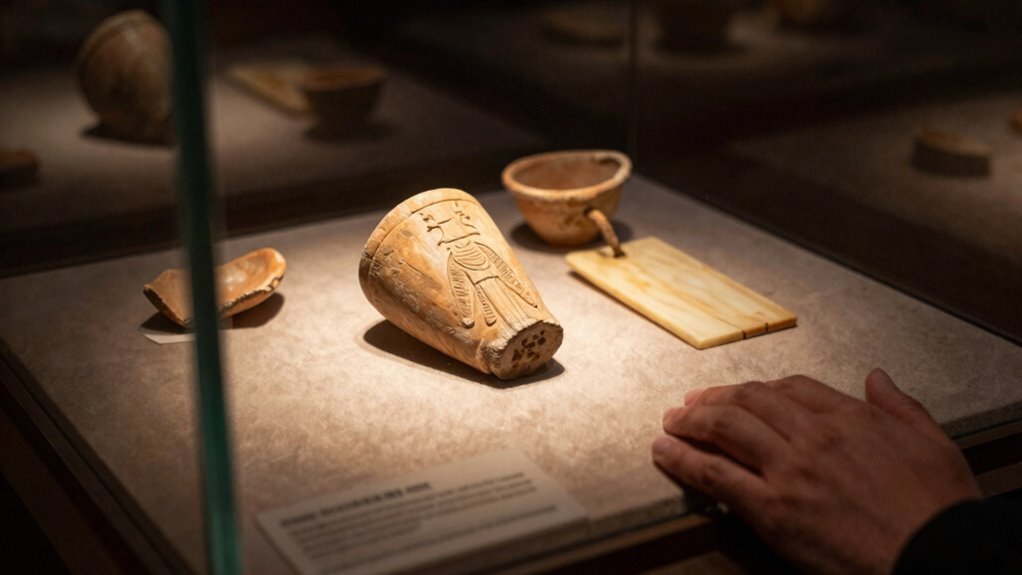
Seal impressions from Abydos’ royal necropolis decisively anchor Narmer at the head of the First Dynasty: multiple clay sealings recovered in and around the tombs at Umm el-Qa’ab list Narmer before Hor-Aha and, in the complete Qa’a sealing, present the uninterrupted sequence of eight early dynastic kings beginning with Narmer.
Abydos seal impressions firmly place Narmer atop the First Dynasty, preceding Hor-Aha in the royal sequence.
You should weigh seal provenance and stratigraphic context heavily: these sealings come from secure tomb contexts, tying inscriptions to specific royal burial assemblages.
Artifact distribution further supports Narmer’s centrality, with his serekh attested across Lower Egypt and into Canaan.
While inscription variability on isolated seals invites debate over name-equivalence (Menes vs. Narmer vs. Hor-Aha), the aggregate necropolis evidence, consistent placement and multiple independent impressions, carries decisive archaeological weight.
Narmer’s role as founder of the First Dynasty is corroborated by these multiple independent lines of evidence.
Ancient Sources Listing Menes: Manetho, Palermo, Abydos – Reliability Assessed
When you weigh the ancient literary and monumental records that name Menes, you must balance their chronological distance, genre, and corroboration with archaeology: Manetho’s Aegyptiaca, written in the third century BCE, provides a narrative framework and reign lengths but mixes folklore and lost source material; the Palermo Stone offers nearer-contemporary annalistic entries that can be tied to early dynastic administration yet leave room for interpretive uncertainty; and the Abydos and Turin king lists, compiled in the New Kingdom, preserve a long-standing traditional sequence but reflect two millennia of memory and ideological selection.
Manetho supplies chronology and legend, challenging source credibility.
Palermo Stone gives near-contemporary administrative data.
Abydos/Turin lists repeat a traditional name, “Meni.”
Textual transmission over centuries introduces omissions and conflation.
Lack of decisive archaeology makes Menes likely a composite or honorific.
Archaeological consensus still favors Narmer as a better-documented candidate for the early unifier of Egypt, based on artifacts like the Narmer Palette and other contemporaneous material that point to strong material evidence.
Could Hor-Aha (or Another King) Be the Real Founder?
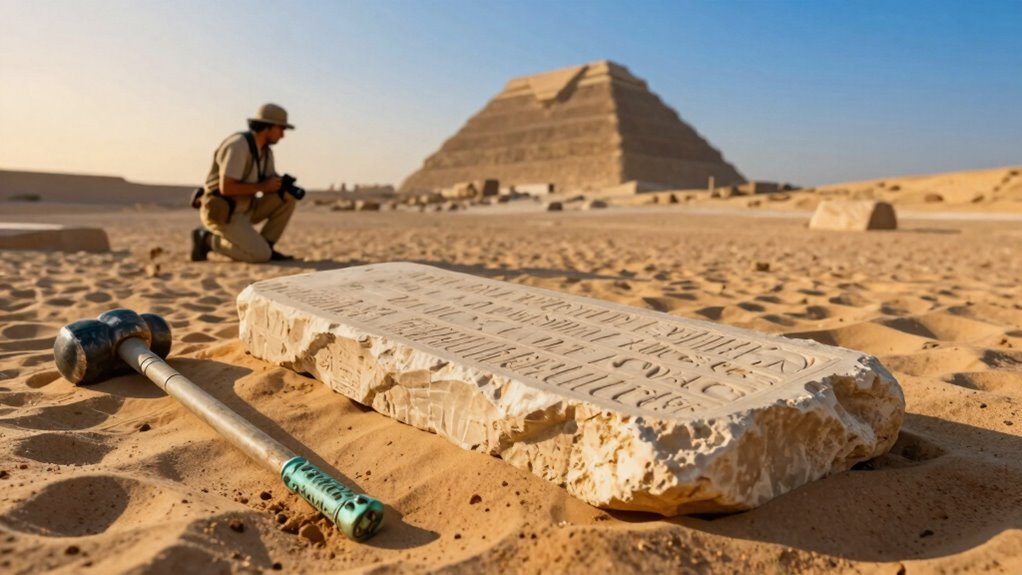
Although Narmer often gets credit for Egypt’s unification, recent readings of contemporary seals, king lists, and administrative records make a persuasive case that Hor‑Aha, or another early First Dynasty ruler, could be the practical founder of the unified state.
You’ll note seals from Umm el‑Qa’ab and the Palermo Stone place Hor‑Aha prominently, and king lists in Den’s tomb record him immediately after Narmer, prompting Succession controversies.
You should weigh his Memphis founding, strategic for river control and centralized travel, alongside clear evidence of Administrative consolidation: bureaucratic year‑tables, seal impressions, and capital administration practices matured under his reign.
Religious innovations, the Henu‑bark depiction, visits to Neith’s sanctuary, and new cult foundations further suggest a ruler who institutionalized the unified Egyptian state.
Primary evidence for this period is limited to a handful of monuments and objects bearing royal names, including key artifacts such as the Narmer palette.
How Historians Reconcile Narmer, Menes, and Royal Titles
Because ancient records mix regnal names, honorifics, and retrospective traditions, historians have to read Narmer, Menes, and related titles as overlapping identities shaped by different kinds of evidence.
You’ll weigh late king lists and classical reports that name Menes against clear archaeological artifacts—Narmer’s Palette and mace—that signal unification.
Flinders Petrie’s influential solution treats Narmer as the regnal name and Menes as an honorific; other scholars still propose Hor-Aha or composite traditions.
You should also note how media representations and myth evolution affect public perception, amplifying Menes as a founding figure despite scant material trace.
- Narmer: strong archaeological presence
- Menes: prominent in king lists
- Petrie: Narmer = Menes hypothesis
- Alternatives: Hor-Aha or composite figure
- Symbols: crowns and royal regalia
Recent discoveries at Abydos, including the monumental tomb and rich grave goods associated with Meret-Neith, add complexity to interpretations of early rulership.
What the Record Doesn’t Tell Us: Dating, Gaps, and Ambiguous Names
You’ll find that the surviving king lists and inscriptions give you an irregular, often contradictory chronology.
Accession ages and reign lengths fluctuate wildly and sometimes conflict with archaeological or astronomical dates.
Incomplete or damaged entries—along with name corruptions from later transcriptions—mean the lists omit rulers, conflate identities, or record nominal reigns that may reflect ideology rather than actual rule.
Any reconstruction you accept must consequently treat these sources as partial, patterned testimonies rather than a continuous, unambiguous timeline.
The first native pharaonic dynasties arose around c. 3100 BC.
Dating Uncertainties
When you try to fix the First Dynasty into calendar years, the sources push and pull against one another: radiocarbon assays often place early dynastic events centuries later than traditional king lists and archaeological chronologies, Manetho’s politically shaped narrative conflicts with sealings and tomb inscriptions, and astronomical markers like Sothic risings hinge on uncertain attributions.
You’ll face radiocarbon anomalies that push Hor-Aha into the mid-24th century BCE against traditional early 31st-century dates, and heliacal calculation depends on which ruler commissioned the observation.
You must weigh sealings naming Narmer, variable reign lengths, and gaps in material evidence.
The result is a spectrum of plausible chronologies rather than a single secure timeline.
- Radiocarbon anomalies vs king lists
- Narmer vs Hor-Aha attribution
- Sothic/heliacal calculation issues
- Tomb-sealing evidence limits
- Methodological bias and gaps
Additional chronological debates also draw on comparisons with neighboring polities and later Egyptian synchronisms, especially when anchoring reigns to broader Near Eastern timelines, which highlights the need to consider archaeological synchronisms.
Incomplete King Lists
Although the king lists that survive from ancient Egypt give the appearance of a continuous lineage, they’re deliberately partial and often misleading, so you can’t treat them as straightforward chronicles.
You must read them critically: the Abydos List, Turin papyrus, and Saqqara compilations reflect political choices that produce regional omissions and gender exclusions.
Ramesside editors erased Amarna rulers and many Second and First Intermediate Period kings; entire local dynasts appear only at Abydos or not at all.
Female sovereigns like Sobekneferu vanish from official tables despite archaeological evidence.
Variant throne, nomen, and Greek renderings further scramble identities, while fragmentary recovery leaves gaps.
To reconstruct succession you need cross-referencing, palaeographic sensitivity, and acceptance of persistent uncertainty.
In addition, several short lists and inscriptions—such as Giza writing-boards and the Wadi Hammamat list—provide corroborating but limited evidence for specific rulers, highlighting the need to consult multiple sources.
Why Identifying the First Pharaoh Matters for State Formation
Because identifying Egypt’s first pharaoh anchors the moment when fragmented chiefdoms coalesced into a centralized territorial state, it lets us trace how political authority, administration, economy, military power, and culture were deliberately reorganized rather than accidentally consolidated.
You can see how Narmer’s act established political legitimacy, standardized state symbolism like the double crown, and created durable institutions.
Tracing that origin clarifies mechanisms of succession, taxation, bureaucracy, and military integration that sustained millennia of stability.
It also shows how symbolic unity enabled economic and cultural consolidation across diverse regions.
- Establishes political legitimacy and dynastic precedence
- Explains administrative standardization and bureaucracy
- Connects economic integration of Nile regions
- Illuminates unified military command and security
- Reveals cultural and religious standardization through state symbolism
- Archaeological evidence such as the Narmer Palette and early king lists provides concrete markers for this transition.
Scholarly Consensus Today : and What Evidence Could Change It
Having laid out why pinpointing Egypt’s first pharaoh matters for understanding state formation, we now need to assess where scholars stand and what could make them change their minds.
You should know the mainstream view credits Narmer. Palermo Stone fragments, Abydos necropolis seals, and the Narmer Palette’s twin crowns frame him as First Dynasty founder and unifier.
Alternative readings link Menes or Hor‑Aha to the same episode: Menes may be an honorific or refer to Hor‑Aha.
Consensus rests on the weight of administrative records and material culture. Clay seal impressions, ivory labels, and inferred shifts in regional administration and ceremonial rites support it.
A decisive discovery—intact Palermo Stone registry, clear Menes administrative archives, or new inscriptions tying names to offices—would force reappraisal of succession and identity. New archaeological finds could also clarify whether Narmer unified Egypt or if another ruler should hold that title.
Frequently Asked Questions
How Reliable Are Radiocarbon Dates for Narmer-Era Contexts?
They’re moderately reliable but limited: radiocarbon calibration and reservoir effects introduce notable uncertainty for Narmer-era contexts.
You’ll get useful date ranges (often 3300–2900 BCE) yet calibration plateaus and old-wood/reservoir effects can shift results by decades to centuries.
You should consequently combine multiple samples, secure stratigraphy, ceramic typology and astronomical or comparative anchors to refine chronologies; lone C-14 dates shouldn’t be treated as definitive.
What Archaeological Sites Best Show Early Royal Administration?
Imagine bureaucrats in linen wigs arguing over inventory like ancient sitcom clerks.
You’d point to Hierakonpolis Deposits and Abydos Tombs as the clearest evidence: monumental enclosures, sealings, and labels show centralized accounting and ritual provisioning.
Saqqara mastabas, Tell el‑Farkha granaries and elite workshops corroborate administrative offices, titles, and storage control.
Together these sites map a nascent royal bureaucracy, standardized record‑keeping, and territorial oversight in early state formation.
Did Narmer Use Different Royal Titulary Than Later Pharaohs?
Yes. You’ll see Palette evolution and Titulary variation show Narmer used a simpler titulary than later pharaohs.
Archaeological serekhs record only his Horus-name, Horus Narmer, without nebty or prenomen elements that appear later.
As titulary variation developed, successors added nebty, nesut bity and other titles; Narmer’s single-name usage and double crown imagery reflect an earlier, less elaborate royal naming practice during unification.
How Did Unification Affect Non-Elite Communities Culturally?
You experienced cultural homogenization: state-sponsored local rituals displaced many community ceremonies, while material continuity persisted in everyday objects and practices.
You saw regional dialects and artistic forms marginalized as administrative standards and monumental styles spread.
Temple-centered religion professionalized, narrowing non-elite spiritual roles, yet household cults and craft techniques maintained continuity.
What Role Did Trade Networks Play in Early State Consolidation?
You used trade networks to bind early Egyptian regions by leveraging maritime exchange and resource specialization.
You controlled Nile Delta routes and southern Nile valleys to centralize surplus, standardize measures, and monopolize luxury imports.
You redirected exotic goods to elites, funded monuments, and disciplined regional elites through redistribution.
Conclusion
You can’t point to a single, unambiguous “first” pharaoh; the evidence, Narmer’s prominent iconography, later king lists naming Menes, and early sealings overlap like braided strands suggesting a single founding figure.
Scholars thus treat Narmer/Menes as overlapping identities or successive leaders who forged unified rule.
This uncertainty matters because it shapes how you read state formation: the origin remains a composite portrait, not a single photograph, open to revision with new finds.
0 Comment