
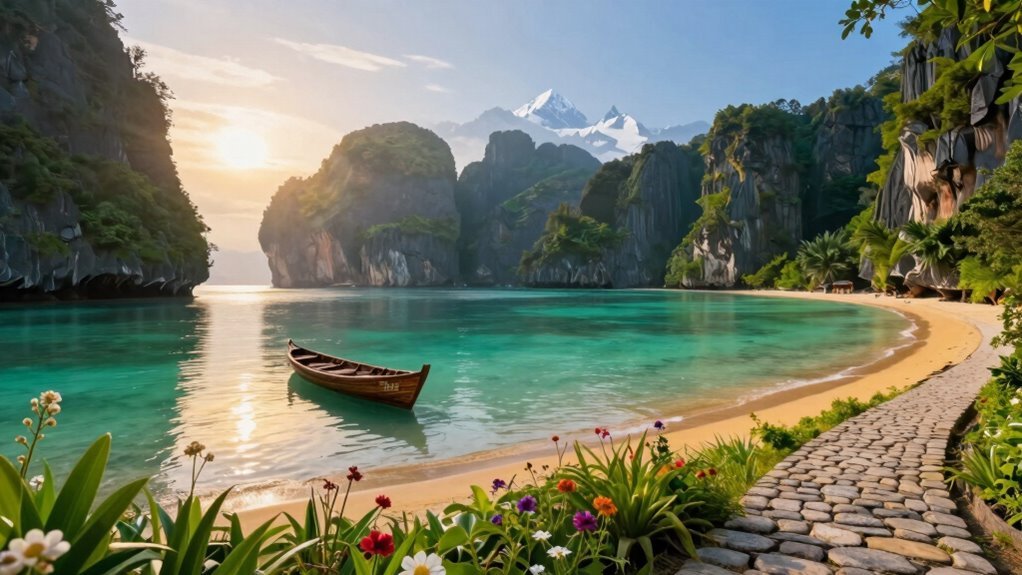

You’ll watch sunrise spill gold over Machu Picchu’s terraces, breathe misty spray beneath Vernal and Nevada Falls, and ride gondolas above Banff’s pine-scented hush.
Hike jagged Dolomite ridgelines, plunge by helicopter into the Grand Canyon’s banded depths, and surf Huacachina’s towering dunes at sunset.
Climb Lindos’ Acropolis for Aegean panoramas, stand atop Top of the Rock as Manhattan lights bloom, or stroll Dunkery Beacon’s wind‑blown moor, keep going to uncover tips, routes, and timing for each spot.
Key Takeaways
- Consider iconic, diverse landscapes worldwide: ancient ruins, alpine peaks, dramatic canyons, tropical beaches, and desert oases.
- Prioritize seasonal timing for best conditions: sunrise/sunset light, peak waterfall flow, whale season, or dune-stable evenings.
- Balance access and experience: helicopter or gondola for panoramas, pre-dawn hikes for solitude, or guided 4x4s for remote dunes.
- Pack appropriate gear: layered clothing, waterproofs, grippy shoes, headlamp, sun protection, and water for varied terrains and climates.
- Combine nearby extensions to deepen visits: e.g., Choquequirao after Machu Picchu, Panorama Trail beyond Vernal, or Banff gondola plus park trails.
Machu Picchu : Sun Gate Sunrise Arrival
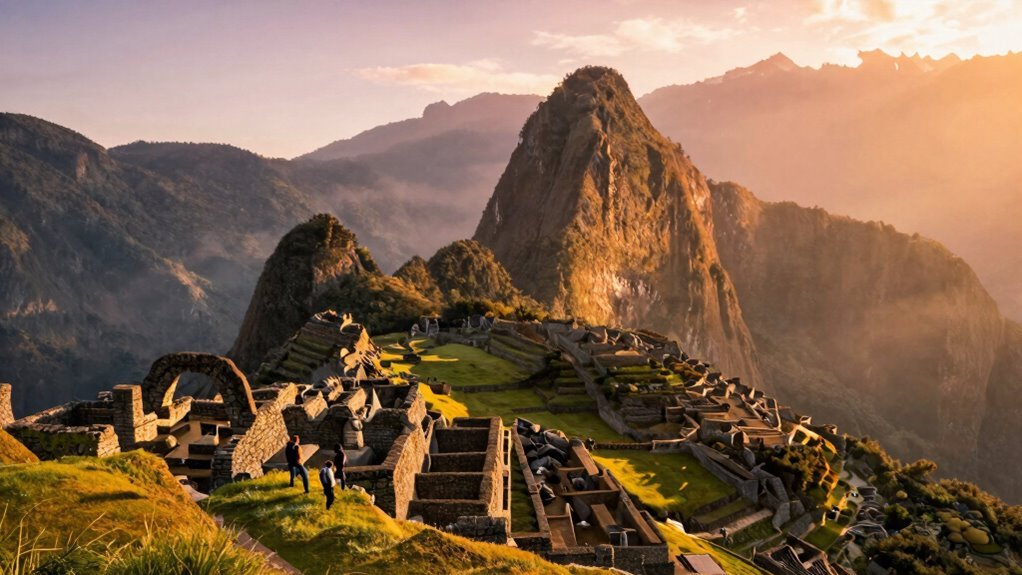
When you crest the final stone steps at the Sun Gate just before dawn, the first pale light slices through a curtain of cloud and Machu Picchu slowly materializes—terraces like ribbed shoulders, jagged peaks breathing mist, and the faint, cool scent of wet earth rising from the valley below.
Cresting the Sun Gate at dawn, pale light parts clouds to reveal terraces, misted peaks, and the scent of wet earth.
You’ve earned this view after the Inca Trail’s relentless rhythm: mornings shrouded in fog, the weight of pack and altitude, and shared silence with other hikers.
As terraces reveal terraces, you feel the site’s sacred geometry and Inca ingenuity—the drainage, the alignments—unfolding in quiet clarity.
Plan to arrive pre-dawn in layers, use a headlamp for the final switchbacks, and let the citadel’s slow disclose move you. Many visitors also explore nearby sites such as Choquequirao for an extended sense of Inca scale and solitude.
Vernal Falls (Mist Trail) : Get Up Close to Nevada Falls
You’ll feel your heart race as you tackle the Mist Trail’s steep granite steps — each switchback bringing the thunder of Vernal Fall closer. With your waterproof jacket zipped and your boots gripping the stone, you get the spray-soaked face and that sharp, mineral river scent right away.
Pause at the Hanging Rock and peer down at Nevada Falls’ plunge and the emerald pool; in that moment you’ll understand why this route is a rite of passage for Yosemite visitors.
Mist Trail Challenge
Strap on your boots and brace for mist: the Mist Trail rockets you up a steep 3-mile round trip to Vernal Fall and, if you push on, another climb to Nevada Fall, gaining about 1,000 feet to Vernal and roughly 1,900 feet to Nevada. You’ll feel spray like a living curtain, hear thunderous water, and taste cool alpine air as stone steps slick beneath your soles.
On this Yosemite National trail, locals revere the route for its drama and seasonal power; hikers trade tips about timing, layers, and where to pause. Move carefully on worn granite, use handrails on exposed sections, and start early to dodge crowds.
Bring quick-drying clothes, protect electronics, carry water, and respect closures for safety. Consider extending your trip to explore nearby Banff National Park for more alpine scenery and hiking.
Nevada Falls Vantage
Though the steps keep rising and the spray keeps coming, reaching the granite ledge above Nevada Falls stops you cold: the 594-foot drop roars beneath your feet, mist perfumes the air, and the Merced River scours the canyon into a tumble of white and slate.
You’ve climbed the steep 3-mile Mist Trail route from Happy Isles, gaining roughly 1,000 feet, and now stand on a sheer hanging rock edge where the cascade’s power is immediate and humbling.
Stone steps carved into cliff lead here; waterproof layers and grippy shoes pay off. In late spring the flow and rainbows stun, while late summer eases footing.
From this vantage you can continue onto the John Muir or Panorama Trail for broader panoramic views.
Switzerland’s dramatic alpine scenery, including iconic peaks like the Matterhorn, rivals Yosemite for jaw-dropping mountain vistas.
Waterfall Spray Experience
Often the trail narrows into a spray-drenched tunnel of cool air and thunder, and you’ll feel Vernal Falls before you see it. The mist stings your face, the granite steps gleam underfoot, and the roar of 317 feet of falling water fills your chest as the river shreds itself into froth.
You climb the Mist Trail, gaining 1,000 feet in two miles, wet boots slapping slick stone as steam-like spray cloaks you. From the footbridge the cascade hits like a drum; continue the John Muir connection to stand above Nevada Falls’ hanging lip.
Expect wind-driven mist, slippery sections, and summer crowds. Start early. Pack waterproof layers, traction for icy seasons, and check reservations if you’re combining routes.
The vast glaciers and flightseeing opportunities in places like Wrangell-St. Elias offer similarly epic glacial perspectives for travelers seeking more remote ice-carved landscapes.
| Feature | Tip |
|---|---|
| Spray intensity | Wear waterproof layers |
| Surface | Traction advised |
| Crowds | Start early |
| Permits | Day hikes usually permit-free |
Dolomites (Cortina) : Ski‑Peak and Aerial Viewpoints
Rising out of the Ampezzo Basin like a cathedral of pale stone, the Cortina peaks give you panoramic vistas that feel cinematic—jagged limestone spires cut into the sky, wind carrying the tang of snow or wildflowers, and light that paints the cliffs gold at sunrise and crimson at sunset.
In the Dolomites around Cortina d’Ampezzo you can ride lifts to ski‑peak viewpoints on Faloria, Tofana and Lagazuoi, emerging above cloud banks to stare at serrated ridges and deep cirques.
In winter rifugi and summit terraces offer 360° views stretching to Austrian peaks; in summer via ferrata and trails bring you face to fossilized cliffs.
Weather shifts fast—use gondolas to climb to 2,500–3,000 m for the best aerial panoramas.
The island nation also offers coastal marine conservation at sites like Blue Bay that protect vibrant coral reefs and snorkeling habitats.
Sulphur Mountain, Banff : Banff Gondola Panoramas
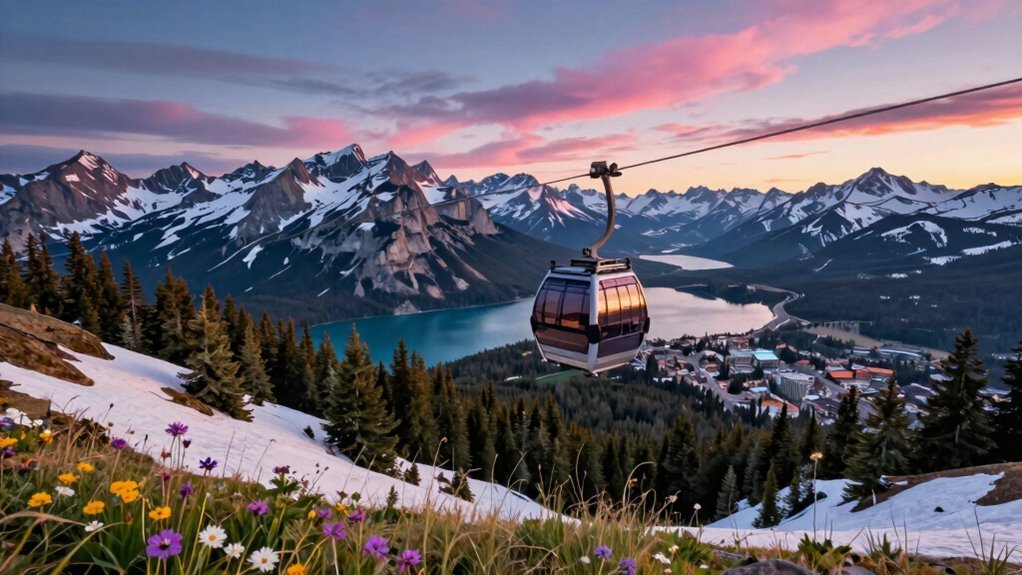
You’ll glide up Sulphur Mountain in the Banff Gondola — the 8–10 minute ride trades town noise for the hush of pine and the scent of cold alpine air.
At the Upper Terminal, the boardwalk and Sky Bistro open up sweeping vistas: Mt. Rundle, the Bow Valley and ribboning rivers — especially sharp and gold at sunrise or bruised-pink at sunset.
Weather permitting, you can linger with a camera and the Cosmic Ray Station’s interpretive panels and watch light paint glacial peaks and meadows across 50–100 km of Rockies.
Many visitors also pair a gondola trip with nearby national parks to extend their alpine exploration and experience more of the region’s protected wilderness.
Gondola Ride Experience
A swift cabin carries you from downtown Banff to the rocky crest of Sulphur Mountain in about eight minutes, where crisp alpine air, panoramic boardwalks, and the roll of the Bow River far below unfold around you. In the Banff Gondola you feel the gentle hum and slight sway as valley floors shrink and jagged peaks grow; glass frames a moving mural of Mount Rundle and Cascade Mountain.
Year-round runs mean you can chase golden sunsets or snow-quiet mornings, and timed tickets keep crowds steady so you soak it in. At the summit, interpretive exhibits and the Sky Bistro add cultural context and local flavors, while combo passes and reduced fares make this one of Banff’s beautiful destinations and Top Attractions. Many visitors pair the gondola with nearby sightseeing like the Avenue of Sphinxes or temple visits when planning broader cultural itineraries.
Sweeping Mountain Vistas
From the gently humming gondola cabin to the boardwalk’s wind-swept ridge, the summit rewards you with sweeping mountain vistas that stop the breath and sharpen the senses.
You step from the Banff Gondola into thin, cool air and a panorama that lays the Canadian Rockies at your feet: jagged ridgelines, Mount Rundle’s profile, Cascade Mountain’s shoulders, and the Bow River threading silver through the valley.
The interpretive Cosmic Ray Station and Sky Bistro give cultural context and a warm place to linger as marmots chatter and alpine winds sharpen pine scent.
Trails are short and kind; Sulphur Mountain’s boardwalk is an easy high-altitude fix, yet weather shifts fast, so you’ll dress in layers and savor every crisp view.
The region’s commitment to conservation and pristine environments echoes the same clean environment values that make places like New Zealand renowned for their natural beauty.
Sunrise And Sunset Views
When dawn breaks over Sulphur Mountain, the gondola dumps you onto a rim of light where jagged ridgelines catch alpenglow and the Bow Valley slowly brightens beneath a ribbon of turquoise river; air tastes thin and crisp, marmots nap as photographers steady tripods, and the summit’s interpretive panels and indoor viewpoints let you shift from chilled boardwalk to warm refuge without missing a single changing hue.
You’ll ride the Banff Gondola in eight minutes to a 2,281‑meter perch where Sunrise paints glaciers and valleys in molten pink, then later watch Sunset lay long shadows across Banff National Park while lakes mirror the sky. Slot reservations beat crowds; bring layers, a camera, and respect for fragile alpine ecology. The area’s proximity to national parks and extensive outdoor activities makes it a prime base for exploring the broader region.
Grand Canyon : Helicopter Rides and Rim Views
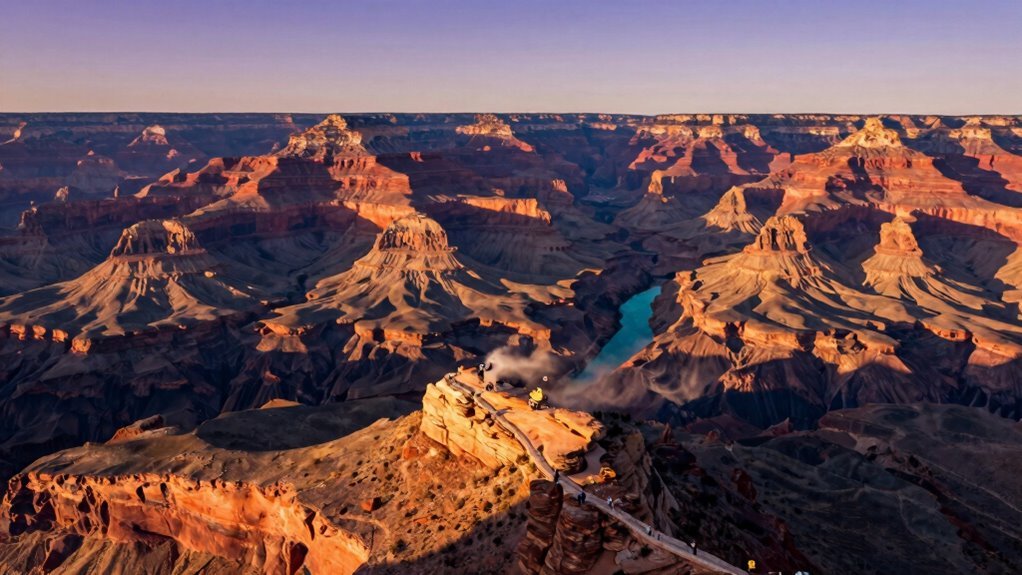
Often you’ll feel the canyon’s scale most viscerally from above, as turbines whisper and the helicopter dips into shadowed chasms, revealing banded walls that glow from rust-red to ochre in the sun. You’ll launch from Las Vegas or Grand Canyon airfields on helicopter tours that plunge low for striped-rock vistas, narration tracing billions of years of geology and the Colorado River threading the Inner Gorge.
Landings on the canyon floor or remote plateaus let you step into silence, toast with champagne, or follow a guide on a short trek when permits and weather allow. Back on the rim, South Rim viewpoints bustle with sunrise crowds while the higher, quieter North Rim rewards you with rarer, seasonal solitude. The region’s dramatic skyline is dominated by towering peaks such as Gangkhar Puensum, which highlights the contrast between arid canyon landscapes and the Himalayan grandeur.
Lion’s Head, Cape Town : Sunset Picnic and Whale Spotting
Climb Lion’s Head late in the afternoon and stake out a sunset picnic spot where the sea, Table Mountain and Robben Island unravel beneath you in a sweeping panorama; bring a blanket and a chilled bottle, because as the sun sinks the sky flushes pink and the ocean turns gunmetal, lending a hush to the city below.
Stake a sunset picnic on Lion’s Head—blankets, chilled bubbles, and a pink‑washed skyline over sea and city.
You’ll hike a 1.5–2 hour circular trail of rock and short scrambles, gripping fixed chains near the top as wind teases your hair. Locals cherish this ritual—blankets, bubbly, shared silence.
Scan the water for southern right and humpback whales (June–November) and seals playing by ships that punctuate the horizon.
Start early enough to avoid descent in darkness, wear sturdy shoes and carry water for a safe, unforgettable moment among Beautiful Places.
Huacachina, Peru : Dune‑Sunsets and Adrenaline Rides
Lose yourself in Huacachina’s otherworldly hush as the sun slides low and the dunes flare copper and gold, their wind-sculpted ridges casting long, clean shadows across the lagoon’s glassy surface. You’ll feel grit on your lips and a slow, soft wind that smells faintly of warm sand and distant vineyards.
This tiny desert oasis, perched near Ica, is one of the world’s most compact spectacles: towering dunes demand your courage for dune bashing in 4x4s and sandboarding down steep, shimmering faces. Guided sunset tours pause for photographs as the lagoon mirrors dramatic color contrasts.
Afterward you can linger in a hostel or boutique hotel, sample nearby winery offerings, or slot Huacachina into a broader southern Peru route that includes the Nazca Lines.
Acropolis, Lindos : Strenuous Climb, Town and Sea Panoramas
You’ll feel your pulse quicken as you wind up the steep limestone promontory toward Lindos’ Acropolis, the heat humming off the whitewashed village below and the scent of sun-baked stone and thyme in the air.
You climb, breath shortening, and the Doric Temple of Athena Lindia emerges among Hellenistic and Roman ruins, fortification walls and a medieval castle.
From the summit the 360° views unfold: the honeycomb of the Old Town, crescent Lindos Bay and the glittering Aegean with islets on the horizon.
Go early or late to dodge 40°C and crowds; consider a donkey for part of the ascent or park below and walk the final stretch.
Swim at St Paul’s Bay after the rite of passage.
| Feature | Tip |
|---|---|
| Ascent | Start early |
| Views | 360° panoramas |
| Access | Donkey or foot |
Top of the Rock, New York : Central Park and Sunset Skyline
You’ll want to time your visit so the golden hour bathes Central Park’s Reservoir and Great Lawn while the western skyline lights up behind them.
From the open-air 70th-floor deck you can wander between framed views of the Empire State Building and the wide park panoramas to find the best composition, and sunset slots fill fast—so book ahead.
Bring a fast lens, steady hands or a compact tripod, and take a moment to savor the city’s hum as the lights start to flicker on below.
Sunset Viewing Tips
If you time your Top of the Rock visit for the 30–45 minutes before sunset, you’ll catch Central Park’s trees turning to shadow against a glowing Manhattan skyline and feel the air shift as city lights begin to spark.
Thin clouds can stain the sky in molten pinks and oranges, while a heavy overcast will flatten the view.
Book a timed-entry for the sunset slot, arrive early to claim a rail spot, and listen as the city exhales into evening.
Bring a compact tripod, shoot bracketed exposures, and savor how streetlamps wink on like constellations below.
Practical tips:
- Check sunset time and add transit buffer for MTA delays
- Aim for clear to partly cloudy skies
- Use a small tripod for stable HDR shots
- Frame the Empire State Building in foreground
- Stay 20+ minutes after sunset for peak contrast
Central Park Vistas
From the wind-swept 70th-floor decks of Top of the Rock, Central Park unfurls like a green jewel framed by glass and limestone, its tree-lined rectangles darkening as the skyline glows behind them.
You’ll feel the chill and hear the city’s distant hum as daylight slips away; wind nudges your jacket while avenues light up in neat ribbons.
The tiered platforms let you compose layered views—Wollman Rink, axial streets, and the park’s geometry—perfect for sunset photography without obstruction.
Book a golden-hour slot to catch the color shift from honeyed gold to cobalt, and bring a steady hand or short exposures when lights pop on.
Up here, Manhattan’s pace softens into a shared, shimmering panorama.
Photography Best Spots
Step off the Top of the Rock’s tiered platforms and line up your view: the park’s green expanse anchors a skyline that shifts from honeyed glow to electric pins of light, and this is where you’ll shape the shot.
You’ll feel the cool wind, hear distant traffic, and watch colors roll from gold to deep cobalt as Midtown lights puncture the dusk.
Top of the Rock ranks among the Best places for capturing Central Park and the Empire State Building in a single frame.
- Reserve sunset slots 60–90 minutes before sunset for golden- and blue-hour sequences.
- Use 16–35mm for sweeping park-to-skyline panoramas.
- Bring 70–200mm to isolate landmarks and compress layers.
- Keep ISO 100–400; use a tripod for blue-hour exposures.
- Try different terraces for varied compositions.
Dunkery Beacon, Exmoor : Short Walk to Rolling‑Field and Ocean Views
Though the climb is brief, about a 20‑minute stroll from the car park, you’ll feel the moor’s vastness open up as soon as the rocky summit comes into view.
You stand atop Dunkery Beacon, Exmoor’s highest natural point at 519 meters, where a rugged cairn punctuates the wind and light.
Below, rolling fields and patchwork farmland ripple toward wooded valleys; on clear days you spot the Bristol Channel and even the Irish Sea, coastline and moorland meeting in one sweeping panorama.
The air smells of damp heather and grass, and gusts carry distant sheep bells.
Paths can be boggy after rain, so wear sturdy boots.
Locals treasure this quiet, wind‑blown place for picnics, photography, and contemplative walks.
Frequently Asked Questions
What Is the #1 Most Beautiful Place in the World?
There isn’t one—your #1 depends on what moves you.
You might choose tropical lagoons where turquoise water laps warm sand and fish flash like jewels, mountain monasteries clinging to misty cliffs that echo prayer and incense, or coastal cliffs where wind and gulls carve dramatic silhouettes against sunset.
You’ll taste local spices, hear ancient chants, and feel salt or cold on your skin; pick the scene that steals your breath.
What Are the Top 10 Best Places to Visit in the World?
You’ll want these top 10: Machu Picchu, Patagonia, the Dolomites, Banff, Salar de Uyuni, Antarctica, Kyoto, Venice, the Great Barrier Reef, and New Zealand’s South Island.
You’ll feel mountain railways rumble beneath you, taste street food during cultural festivals, and hear glaciers groan.
You’ll plunge into vibrant underwater adventures, smell pine and sea salt, and meet locals who share stories that stitch landscapes to living traditions.
What Is the #1 Vacation Spot in the World?
There isn’t a single #1 vacation spot—you’ll pick based on taste.
If you crave luxury escapes, you’ll savor Bali’s temples, velvet sunsets, and spa aromas; for budget retreats, you’ll enjoy Lisbon’s pastel streets, bakeries, and lively fado nights; for family adventures, you’ll treasure Orlando’s theme-park thrills, cotton-candy scents, and shared laughter.
Match sensory delights and cultural rhythms to your priorities, and you’ll find the top spot for you.
What Are Some Hidden Gems in India?
About 70% of India’s biodiversity hotspots are in the Northeast, so you’ll find unexpected wonders: wander Sikkim monasteries where incense and prayer flags scent the cold air; explore Meghalaya caves dripping limestone, feel cool water and echoing silence; stroll Konkan beaches with black sand, coconut groves and fiery seafood aromas.
You’ll meet hospitable locals, taste tribal rice beers, and discover landscapes that fuse ritual, geology and cuisine into unforgettable, intimate moments.
Conclusion
You’ve wandered through peaks, ruins and dunes like pages in a weathered travel journal, and each place becomes a different kind of light you carry. Let the mist of Vernal Falls cool your haste, Machu Picchu’s sun gate warm your hope, and Banff’s gondola teach you to breathe slow. Hold the canyon’s vast silence and Huacachina’s roaring sand; these landscapes are mirrors; when you return, you’ll recognize a new horizon in yourself.
0 Comment